

A Brief History of the CAC Website


What is the California Association of Criminalists?
For forensic scientists in California, the CAC is known as a foundational organization. It is one of the oldest regional forensic science organizations in the United States, and members have helped to shape modern criminalistics practice in a wide range of fields.
Lowell Bradford, co-founder and the first CAC Executive Secretary–who served from its founding in 1953 to 1956–wrote and published a treatise on the establishment of the association in the Journal of Criminal Law and Criminology in September 1962. In 1953, a group of sixteen California criminalists started to plan and organize a professional society focused on the latest scientific work being done in crime laboratories throughout the state to share ideas, disseminate and discuss information, and present casework experience.
In 1954, the CAC was formally incorporated, and at its outset, its stated purpose included fostering the exchange of ideas and information, promoting friendship and cooperation among criminalists, and encouraging high levels of competence and ethics in forensic science.
As the CAC grew and developed, it became widely described as the first regional science organization in the United States, and it became a model for the establishment of similar groups in other regions of the country. Membership expanded beyond California to include examiners and practitioners nationwide and internationally. As more specialties (such as chemistry, toxicology, DNA, firearms and tool marks, and questioned documents) were developed within forensic science, they became included under the umbrella of the organization. By the 2000s, membership had grown to nearly 1000, and its policies and ethics standards were frequently consulted in national discussions on forensic standards.
CAC’s Influence and Efforts in National Standards
In 1976, the CAC formed a Criminalistics Certification Study Committee (CCSC) to explore professional certification for criminalists, one of the earliest organized efforts to create a formal credential in the field. Despite initial rejection in 1978 by a national referendum of practitioners, the CAC continued forward with renewed efforts in 1986, and offered the first certification examination in 1989. Since then, efforts to provide a national certification board for criminalists in the United States evolved through the American Board of Criminalistics (ABC).
Responding to calls made in the National Academy of Sciences’ Report, Strengthening Forensic Science in the United States: A Path Forward, aka the NAS Report, the CAC published A Model for a National Code of Professional Conduct in the Forensic Sciences in an effort to codify professional ethical standards for forensic scientists throughout the nation.
Through its early leadership in professional certification and its later initiatives toward ethical and professional standards, the California Association of Criminalists has played a defining role in advancing the professionalization of forensic science. From pioneering certification efforts that ultimately shaped the American Board of Criminalistics to publishing model ethical guidelines in response to the NAS Report, the CAC’s contributions have consistently guided national discourse on competency, integrity, and accountability within the forensic community. Its enduring commitment to excellence continues to influence both policy and practice across the field of forensic science.
How the Emergence of the Internet Changed Communication
As the Internet and the first generation of the World Wide Web emerged in the late 1980s and early 1990s, organizations like the California Association of Criminalists began to move beyond strictly print‑based newsletters, postal mail, and in‑person seminars as their primary means of communication.
For the CAC, the gradual adoption of a website and electronic versions of the CACNews created a centralized, always‑available hub where members could access archives, seminar information, policy documents, and committee materials without waiting for physical mailings. This shift supported faster dissemination of technical articles and announcements, broadened access to historical issues of the newsletter (now spanning decades online), and laid the groundwork for later use of web‑based forms, social media, and other online tools to keep a geographically dispersed membership connected and engaged.
A well-designed website is vital for an organization like the CAC, the oldest regional professional association for criminalists in the United States. As a cornerstone of member communication, the website serves as a central hub where members and the public can access updates on conferences, engage with the forensic community, and stay informed about its operations. The inclusion of the CACNews Archive is particularly significant, as it is the preservation of decades of the association’s history, writing, insights, and advancements in the field of criminalistics. It creates a deeper connection to its members’ legacies.
The Internet and websites have only been around since the late 1980s, but the CAC has endured since the 1950s. By providing this intuitive and freely accessible platform, the CAC enhances engagement with the membership, ensures the continuity of its mission, and upholds its reputation as a trusted, established resource for forensic professionals worldwide.
Enter the CAC Webmasters
From 1996 to 2019, the original three webmasters were Peter Barnett (1996-1998), Mark Traughber (1998-2010), and Eric Halsing (2010-2019). These forward-thinking professionals laid the foundation for the CAC Website as it stands today.
In the Summer 1996 edition of the CACNews, Peter Barnett advertised the first CAC webpage, which the American Board of Criminalistics hosted on their website, https://www.criminalistics.com.
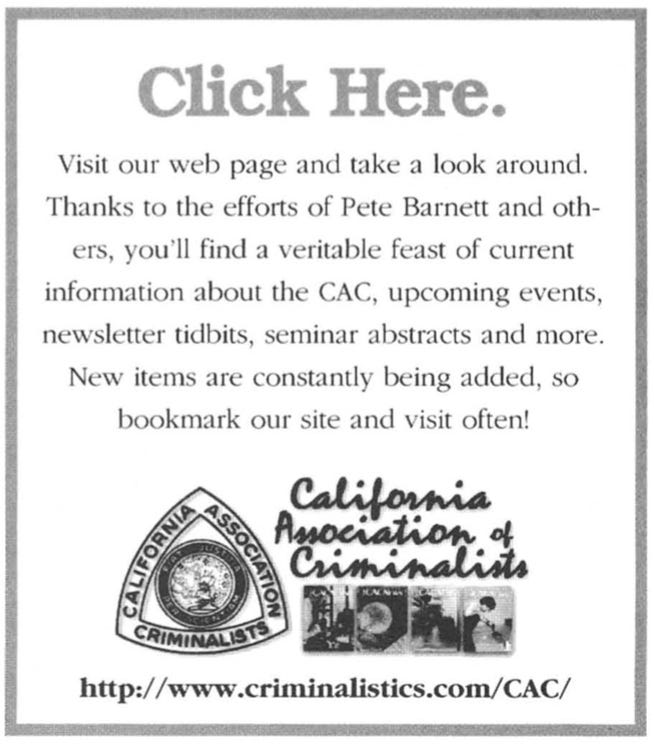
https://web.archive.org/web/19971007021020/http://www.criminalistics.com/CAC/
Adapting from Peter’s first webpage, Mark Traughber had the clarity of vision to create and host the first CAC website in 1998 at https://www.cacnews.org.
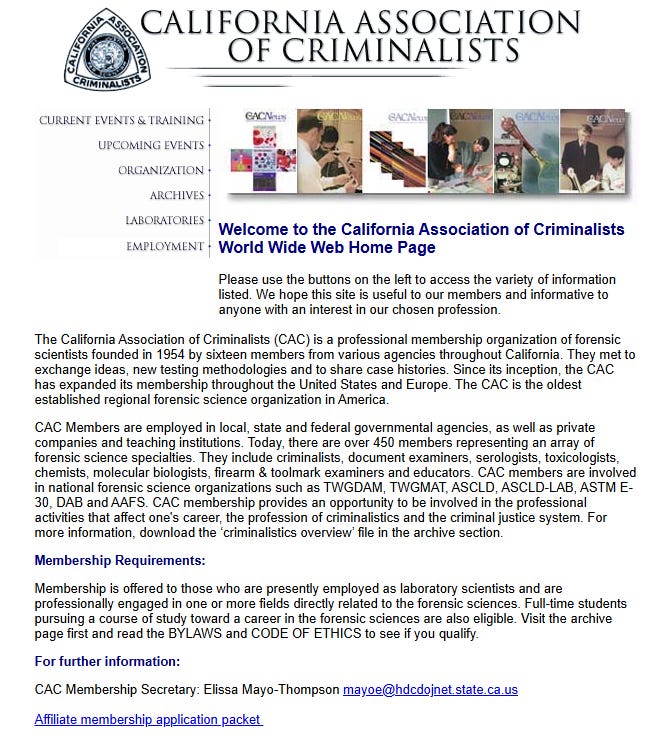
https://web.archive.org/web/20001021022712/http://www.cacnews.org/
Finally, in 2010, Eric Halsing relieved Mark and brought his own creative vision to the CAC’s online presence.
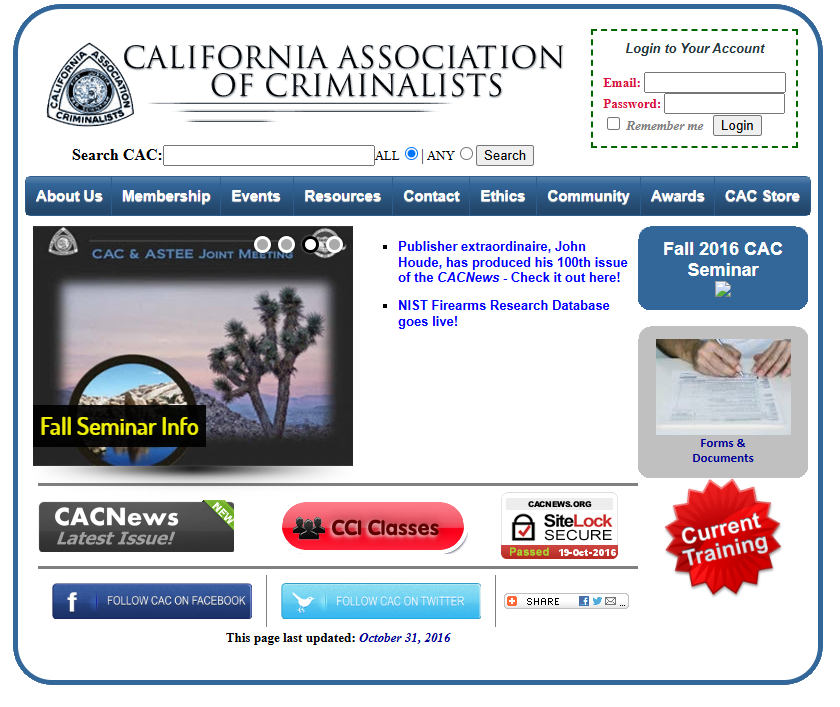
https://web.archive.org/web/20161107040756/http://cacnews.org/
As time went on, the website evolved with current technologies and styling, utilizing images and graphics more than text as the foundation of its interface.
In 2019, I (Stephen Lu) took over from Eric, which brings the website to its current implementation today (January 2, 2025).
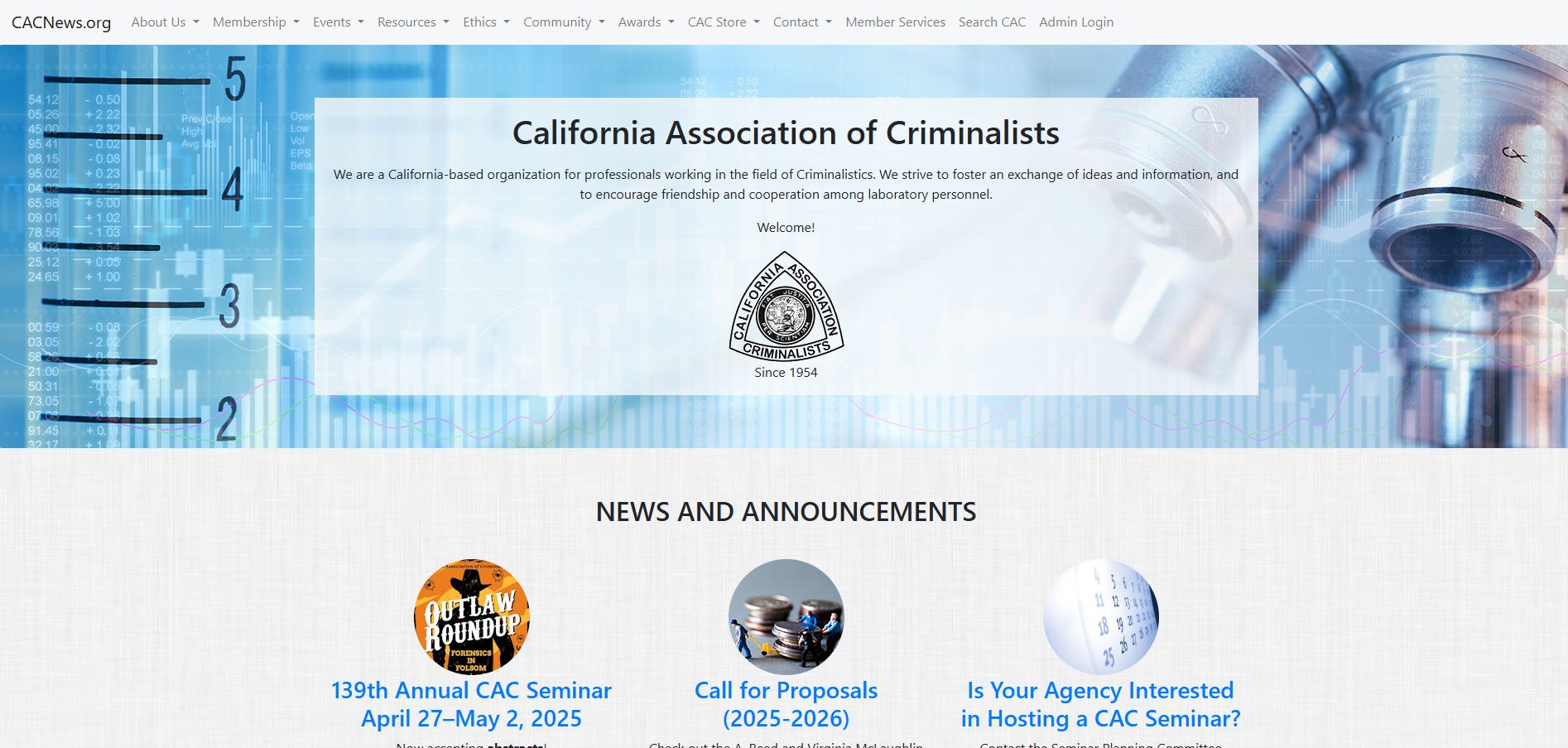
https://web.archive.org/web/20231226083113/https://cacnews.org/
The Webmasters have made recent updates to the important CACNews archive, which includes an archive browser by year and a search function specific to the archive itself.
Building and maintaining a complex website is not a one-person job, as Mark and Eric would probably be able to discuss in detail. Today, the Webmasters are keeping the CAC Website fresh and up-to-date with current technologies and trends to ensure that the CAC legacy will last for many years more.
References
Barnett P. Advertisement for the CAC Webpage. The CACNews. Summer 1996, page 17.
Barnett P. Certification Programs for Criminalists - Historical Development. Forensic Sci Rev. 2008 Jan;20(1):19-43. PMID: 26247341. https://pubmed.ncbi.nlm.nih.gov/26247341/
Barnett P, Gannett C, White J, Thompson J, Jefferson J, Evans H, Murdock J, and DeForest P. A Model for a National Code of Professional Conduct in the Forensic Sciences. California Association of Criminalists. 2011 Feb.
Bradford LW. The California Association of Criminalists. 53 J. Crim. L. Criminology & Police Sci. 375 (1962).